Director of Public Health annual report 2026: Men’s Health
Text version
This year’s Annual Public Health Report explores men’s health and wellbeing, including how societal expectations and traditional ideas of masculinity can influence behaviours that affect health outcomes. These factors can contribute to many of the mental health challenges experienced by men today.
The report looks at the wider issues affecting men’s health, examines the current evidence on men’s mental wellbeing, and identifies ways to improve health outcomes through healthier behaviours and better access to support and healthcare services.
As with previous reports, a number of recommendations are included. These are intended to help partners work together to implement the national Men’s Health Strategy and to highlight key issues in Torbay that require greater focus and action.
Particular attention is given to groups of men with complex needs, including those experiencing severe mental illness, substance misuse, or multiple disadvantages. These groups often face poorer health outcomes and may require additional support to improve their health and wellbeing.
It is hoped that this report will encourage discussion and action across organisations and partnerships in Torbay, helping to turn recommendations into meaningful improvements in men’s health
About this report
This report does not attempt to cover every aspect of men’s health and wellbeing. However, by drawing attention to the topic, the main themes and some of the key issues affecting local men, we aim to identify practical actions and to shape future action. Being healthy isn’t just about avoiding illness. It’s about feeling good, staying active, having positive relationships, and getting support when you need it.
Right now, men face a range of health inequalities that affect both the length and quality of their lives. In Torbay, as well as across England, men are more likely than women to die early from major health conditions, are more likely to die by suicide, and are overrepresented among people experiencing homelessness, substance misuse, and involvement with the criminal justice system. Improving men’s health doesn’t just help individuals – it also benefits families, friends, and communities.
In 2025, the UK Government launched the first national Men’s Health Strategy for England. The strategy aims to:
- Make health services work better for men and boys.
- Help men and boys take control of their own health and wellbeing.
- Create environments where men and boys can thrive physically and mentally.
Achieving these goals will require action from a broad range of different groups, including the NHS, local councils, schools, employers, community organisations, and charities.
This DPH report is informed by the national strategy and will contribute and shape a local response for Torbay.
Men’s Health in Numbers
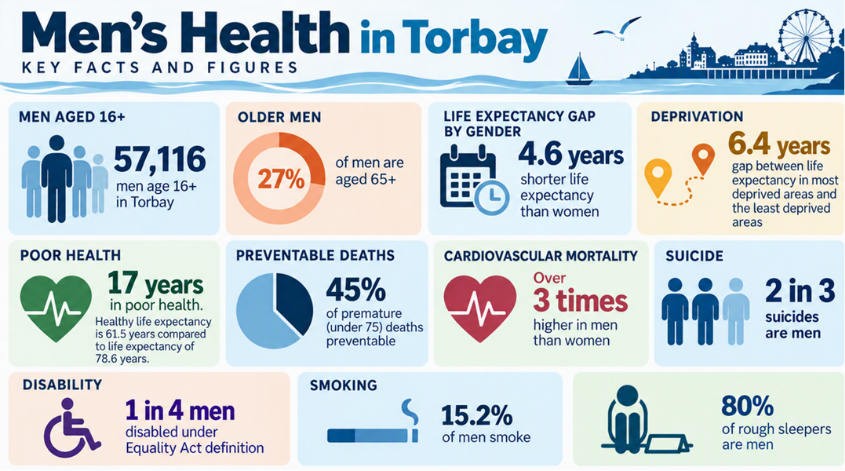
Men’s health in Torbay: Key facts and figures
- 57,116 men are aged 16+ in Torbay
- 27% of men are aged 65+
- Men live on average 4.6 years less than women
- In Torbay there is a 6.4 year life expectancy gap between men who live in the most deprived communities and those that live in the least deprived communities
- Healthy life expectancy for men is 61.5 years, compared to life expectancy being 78.6 years. This means men in Torbay are living on average 17 years in poor health.
- 45% of premature deaths (under 75) are considered preventable (PH 2 page profile)
- Preventable cardiovascular mortality is over 3 times higher in men than woman
- More than 2 in 3 suicides over the last decade (2015 to 2025) in Torbay are men
- 1 in 4 men are considered disabled under the Equality Act definition
- 15.2% of men in Torbay smoke
- 80% of rough sleepers in Torbay are men (MHCLG: Annual Rough Sleeping Snapshot)
Social and cultural norms
Societal norms traditionally associated with being a man can influence behaviours, and how well men access and engage with concepts of health and accessing services.
As the National Men’s Health Strategy points out, norms can also ‘intersect with other characteristics such as age, profession, sexual orientation, deprivation, gender identity, and ethnicity, among others, to impact boys and men (and their health and wellbeing) in unique and diverse ways’
For some men, traditional expectations around strength, independence and self-reliance can create barriers to seeking support, including for mental health concerns. At the same time, masculinity is not inherently harmful. Positive male role models, healthy relationships, strong communities and a sense of purpose can all support better health and wellbeing.
This is also a nuanced picture in terms of the health impact. Positive role models play into and can shift expectations of masculinity at local and societal levels. However, masculine norms can also be used to help men engage with community provision that is informed by ‘traditional’ activities.
Torbay has many strengths, including strong communities, an active voluntary sector and a wide range of organisations working to support health and wellbeing. However, local challenges such as deprivation, poor mental health outcomes and health inequalities continue to affect many men across the Bay.
Sources: Changing gender norms: engaging with men and boys – GOV.UK ; The Importance of Positive Male Role Models – University Of Worcester ; Male role models | Modern masculinities ; Frontiers | The role of activity engagement, social connection, and masculinity norms in men’s shed outcomes for male mental health: a narrative review]
