Complex lives and inclusion health
Stable housing and accessible support services are fundamental to improving outcomes.
Inclusion Health
Men are disproportionately represented among people experiencing complex and socially excluded lives in Torbay. Inclusion health encompasses groups facing multiple and overlapping challenges, including homelessness, substance use, poverty, trauma and contact with the criminal justice system. These experiences can create significant barriers to accessing support and contribute to some of the poorest health outcomes in the population.
Local data shows that men make up 80% of people experiencing rough sleeping and two thirds of those accessing drug and alcohol treatment services, while around 70% of alcohol-related hospital admissions occur among men. This highlights the importance of coordinated, trauma-informed approaches that address the wider determinants of health and ensure services are accessible to those with the most complex needs.
Sources: Torbay JSNA, 2026/7; Homelessness statistics – GOV.UK
Crime, Violence and Opportunities for Change
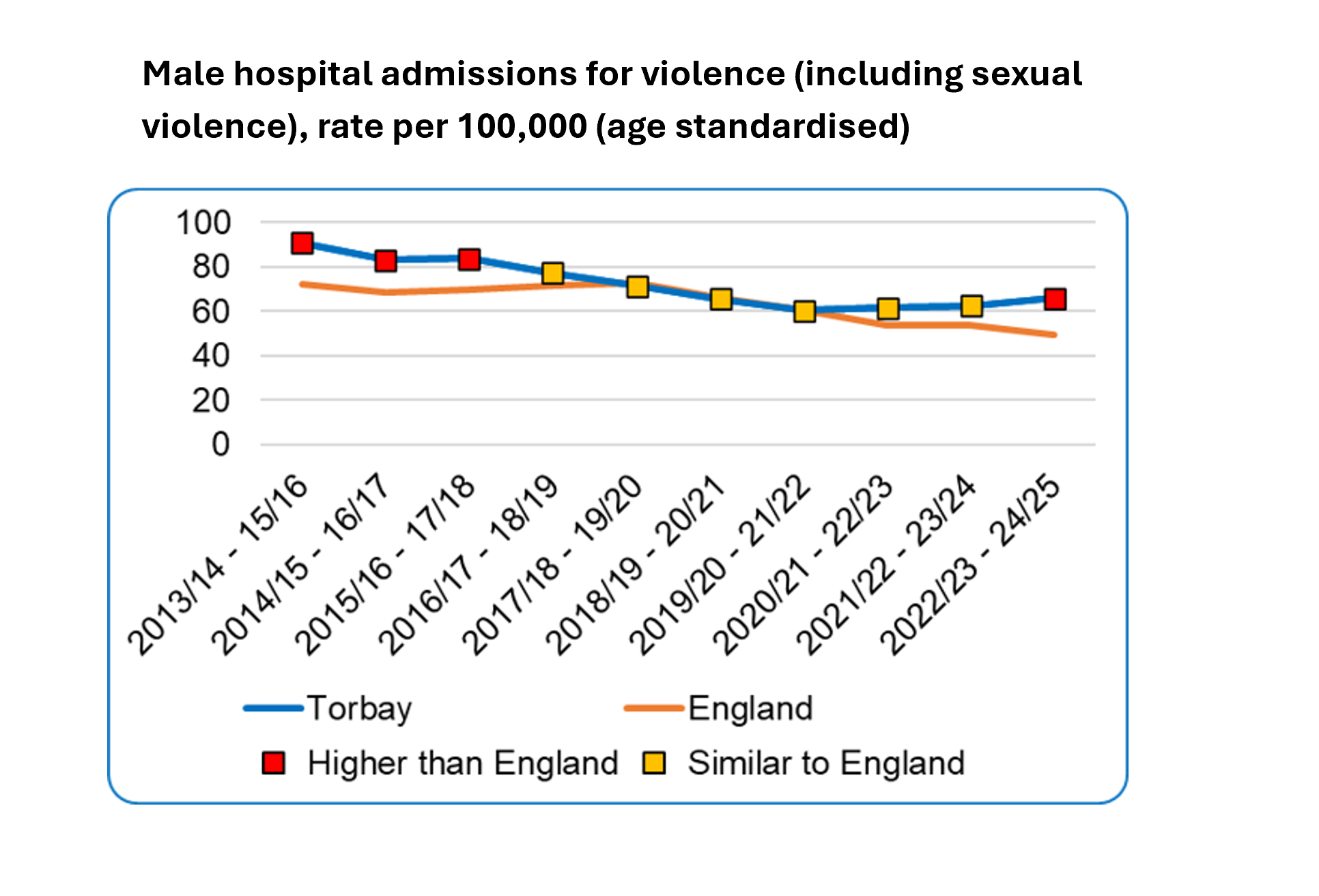
Men are disproportionately affected by both violence and offending, reflecting wider inequalities that influence health, wellbeing and life opportunities. In Torbay, where offenders have been identified, around 70% of perpetrators of violent crime are male.
Men are also more likely to experience the consequences of violence, with hospital admission rates due to violence around three times higher than those for women and significantly higher than the national average.
Outreach and peer approaches can be used to develop more inclusive approaches to more marginalised groups in the community, together with trusted venues and community assets.
Source: Inclusion Health: applying All Our Health – GOV.UK
Case study: Substance use peer outreach programme
People with lived experience of drug and/or alcohol use have been delivering a peer outreach programme with the Hepatitis C Trust since December 2025.
Peers are trained to deliver a range of harm reduction interventions to local people who use drugs.
They have been using their unique skills and relationships to reach different groups of people, especially those not engaged in services, and support them to overcome barriers to treatment and care.
This includes naloxone distribution, needle and syringe provision, dry blood spot testing, linking into drug and alcohol treatment, Hep C treatment, and wider healthcare.
Peers also feed into the Local Drug Information System. This monitors trends in the drug supply, and supports rapid sharing of harm reduction information and alerts with local people at risk.
The programme increases visibility of recovery across a range of community spaces in Torbay, inspiring hope and recovery in the wider community of people who use drugs.
Insights are shared with partner organisations, making sure experiences of people not engaged in services feed into the design of local services.
